A Letter About WIHPP, A-PEERS, and the future of Wisconsin’s Peer Workforce
9/2/26 Hub Announcement from Wisconsin Department of Health Services
Peer support has always been more than a service model. It is a profession and a movement built by people with lived experience, often in response to systems that did not understand, serve, or make space for them.
As Wisconsin continues investing in the peer workforce, I believe we need to pay close attention not only to how many peer positions, trainings, and programs are being created, but to where the funding, authority, infrastructure, and decision-making power are going.
Growth is not automatically the same thing as strengthening the peer workforce - especially if the institutions benefiting most from that growth are not peer-led.
These concerns are not new, and I know peers were raising many of them long before I entered this field. What feels different now is the pace and scale at which larger institutions are moving into spaces that were historically built and led by people with lived experience. The creation of the Wisconsin Hub for Peer Professionals (WIHPP) and UWM’s A-PEERS program only add to my concerns about the increasing institutionalization of peer support, the role of clinical and government systems in defining the profession, and whether community-based peer organizations are being given the resources and room to innovate and build infrastructure of their own.
These are not arguments against partnership with universities, government, or behavioral health systems. They are questions about power, ownership, investment, and the future of a profession that should remain genuinely peer-driven.
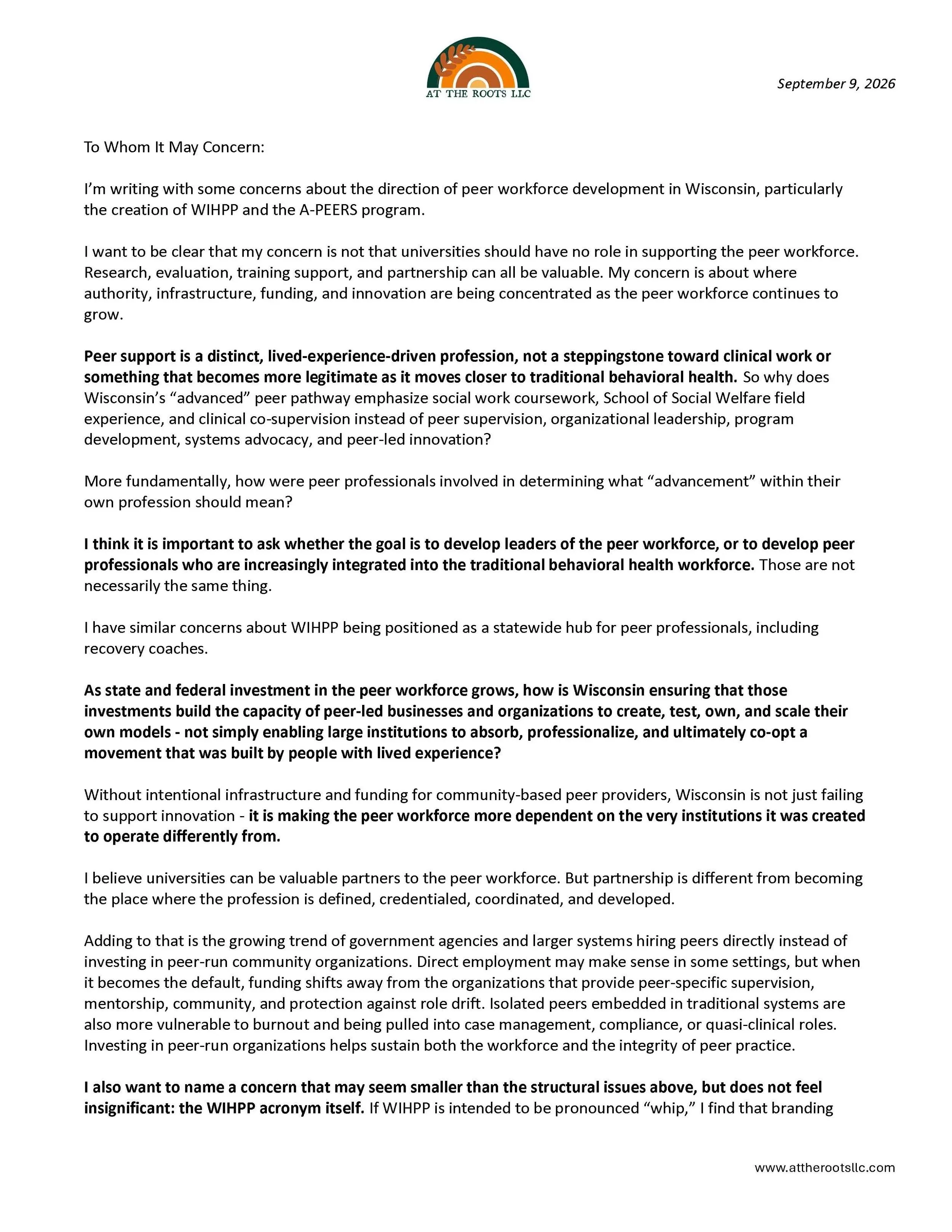
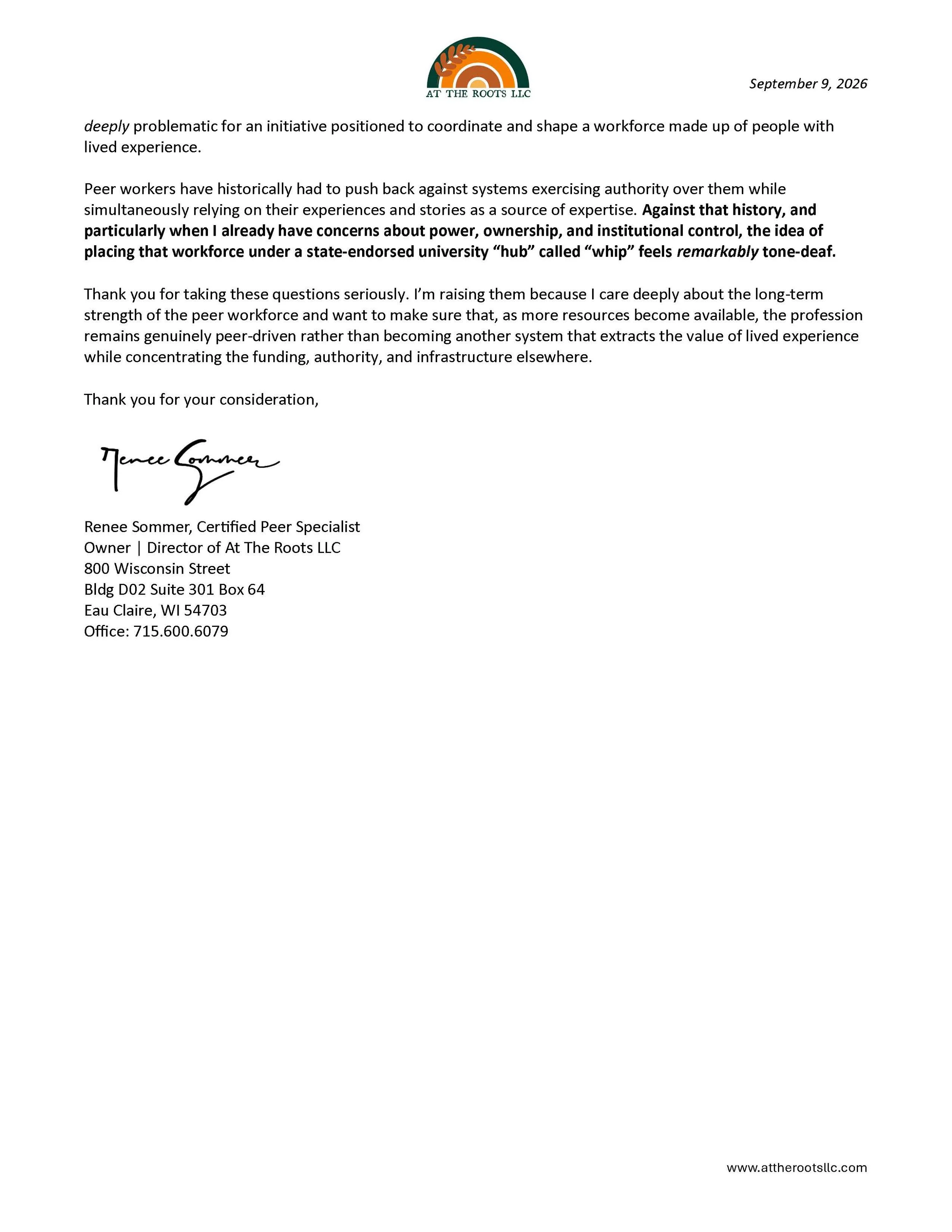
On September 2, 2026, I sent the following letter to the Wisconsin Department of Health Services, UWM’s Center for Inclusive Transition, Education & Employment (CITEE), and some of my local legislators. I’m sharing it publicly because I believe these questions deserve a broader conversation within Wisconsin’s peer community.
(Full Letter Text Copied Below)
*note: the date on the letter is a typo and should have read September 2, 2026
EMAIL CITEE: citee-wihpp@uwm.edu
WI Peer Support DHS/Division of Care and Treatment Services Contact Email: dhsdctspeerspecialist@dhs.wisconsin.gov
For easier reading, here is the full text:
To Whom It May Concern:
I’m writing with some concerns about the direction of peer workforce development in Wisconsin, particularly the creation of WIHPP and the A-PEERS program.
I want to be clear that my concern is not that universities should have no role in supporting the peer workforce. Research, evaluation, training support, and partnership can all be valuable. My concern is about where authority, infrastructure, funding, and innovation are being concentrated as the peer workforce continues to grow.
Peer support is a distinct, lived-experience-driven profession, not a steppingstone toward clinical work or something that becomes more legitimate as it moves closer to traditional behavioral health. So why does Wisconsin’s “advanced” peer pathway emphasize social work coursework, School of Social Welfare field experience, and clinical co-supervision instead of peer supervision, organizational leadership, program development, systems advocacy, and peer-led innovation?
More fundamentally, how were peer professionals involved in determining what “advancement” within their own profession should mean?
I think it is important to ask whether the goal is to develop leaders of the peer workforce, or to develop peer professionals who are increasingly integrated into the traditional behavioral health workforce. Those are not necessarily the same thing.
I have similar concerns about WIHPP being positioned as a statewide hub for peer professionals, including recovery coaches.
As state and federal investment in the peer workforce grows, how is Wisconsin ensuring that those investments build the capacity of peer-led businesses and organizations to create, test, own, and scale their own models - not simply enabling large institutions to absorb, professionalize, and ultimately co-opt a movement that was built by people with lived experience?
Without intentional infrastructure and funding for community-based peer providers, Wisconsin is not just failing to support innovation - it is making the peer workforce more dependent on the very institutions it was created to operate differently from.
I believe universities can be valuable partners to the peer workforce. But partnership is different from becoming the place where the profession is defined, credentialed, coordinated, and developed.
Adding to that is the growing trend of government agencies and larger systems hiring peers directly instead of investing in peer-run community organizations. Direct employment may make sense in some settings, but when it becomes the default, funding shifts away from the organizations that provide peer-specific supervision, mentorship, community, and protection against role drift. Isolated peers embedded in traditional systems are also more vulnerable to burnout and being pulled into case management, compliance, or quasi-clinical roles. Investing in peer-run organizations helps sustain both the workforce and the integrity of peer practice.
I also want to name a concern that may seem smaller than the structural issues above, but does not feel insignificant: the WIHPP acronym itself. If WIHPP is intended to be pronounced “whip,” I find that branding deeply problematic for an initiative positioned to coordinate and shape a workforce made up of people with lived experience.
Peer workers have historically had to push back against systems exercising authority over them while simultaneously relying on their experiences and stories as a source of expertise. Against that history, and particularly when I already have concerns about power, ownership, and institutional control, the idea of placing that workforce under a state-endorsed university “hub” called “whip” feels remarkably tone-deaf.
Thank you for taking these questions seriously. I’m raising them because I care deeply about the long-term strength of the peer workforce and want to make sure that, as more resources become available, the profession remains genuinely peer-driven rather than becoming another system that extracts the value of lived experience while concentrating the funding, authority, and infrastructure elsewhere.
Thank you for your consideration,
Renee Sommer, Certified Peer Specialist
Owner | Director of At The Roots LLC